

Haseeb >|<
Managing Partner of
 Dragonfly
Twitter
观点
This is huge.
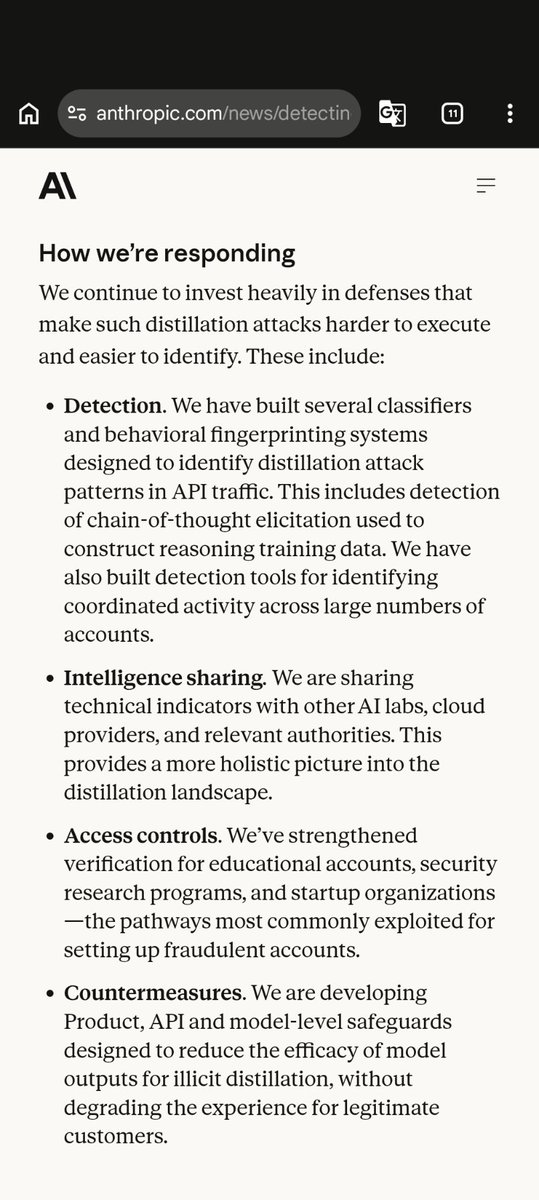
Anthropic has been getting mass-farmed by Chinese Labs across tens of thousands of accounts to use for distillation, which explains why the open source Chinese models have been so good despite having such a big data disadvantage.
It was widely speculated that this was happening, but the scale is staggering. Honestly amazed that it took Anthropic this long to clamp down on this. Explains why they are locking down API usage.
Expect a few things going forward:
* Gap between open source and frontier labs will grow
* US frontier labs will start offering competitive open source models to fill the gap
* APIs will be more restrictive
* Probably more natsec-level restrictions on frontier labs coming soon, more secrecy around labs, less tech diffusion, less leaking secrets across Blue Bottle coffee catch-ups. This is probably good for Google and Anthropic.
With all due respect to Chris, I completely disagree with this take.
Chris argues that "web3," particularly crypto-powered gaming and media, failed due to scams and regulation, and that better regulation will unlock these non-financial cases.
OK, think about this for a second.
Does this pass the smell test?
Do you think web3 gaming failed because of Gary Gensler? Do you think web3 media plays failed because the scammers crowded out the honest media innovators? Really?
If this is true, why didn't they kill financial crypto, which had WAY more of both? Financial use cases were right in the crosshairs of the regulatory harassment, and they also attracted way more scams.
Why shouldn't we instead accept the more obvious answer: non-financial use cases for crypto have failed because no one wants them.
Let's just admit it. They were bad products. They failed the market test. It was not Gensler or SBF or Terra that caused these things to fail, it was that no one wanted any of it. Pretending otherwise is cope.
Enormous sums of capital and talent explored these ideas, and we should acknowledge what we learned. That lesson is not "if we just had better laws, then finally people would finally be using decentralized Spotify" or whatever.
Call a spade a spade. Every single use case in crypto that has worked at scale has been financial in nature.
2008: Bitcoin - non-sovereign store of value
2014: Tether - stablecoins
2015: Ethereum - programmable money
2017: ICOs - capital formation
2018: Prediction markets (Augur, later Polymarket)
2020: DeFi - literally finance is in the name
2021: NFTs - non-fungible financial assets (to the extent they worked)
2024: RWAs (the year BUIDL took off)
All this stuff was adopted bottoms-up. We as investors discovered that people wanted to do these things with crypto. The web3 consumer stuff, on the other hand, was primarily conjured up by investors and pitch decks, ZIRP accelerationism, and "wouldn't it be crazy if" blog posts. This was the opposite of the "what smart people are doing on their weekends" thesis.
In fact, if you go back to the Ethereum white paper from 2014, almost every single Ethereum use case Vitalik describes is financial in nature: token issuance, stablecoins, derivatives, on-chain treasuries/DAOs, on-chain savings, insurance, price feeds, escrow, gambling, prediction markets. It's all in there.
This is nothing to be ashamed of. Finance is almost 10% of GDP. It's an enormous part of the world economy, and banks are some of the lowest NPS score companies in the world. People hate their banks and the outdated financial architectures their money runs on. It's literally why Bitcoin was created. There is so much to innovate in the realm of finance, and I truly believe we are only at the beginning of that displacement. You don't need to assume anything more to project the next 10x in crypto.
The old saying goes "crypto will do to finance what the Internet did to every other industry."
I respect Chris's optimism. But 18 years in, we should not be propagating this meme about consumer web3 use cases as though they're inevitable. If you are hanging around the rim hoping that crypto is going to disrupt media and gaming, you should know the history and look at it with clear eyes.
Now if you as a founder believe that despite that, you know the secret to cracking this market--I respect that, and I certainly don't begrudge anyone to follow their convictions.
But I think it's important that investors be honest that all the evidence points the other way.